How to get more Google reviews
When to ask, the link that removes the friction, and the four common tactics that violate Google's policy or federal law. Written from the actual rules.
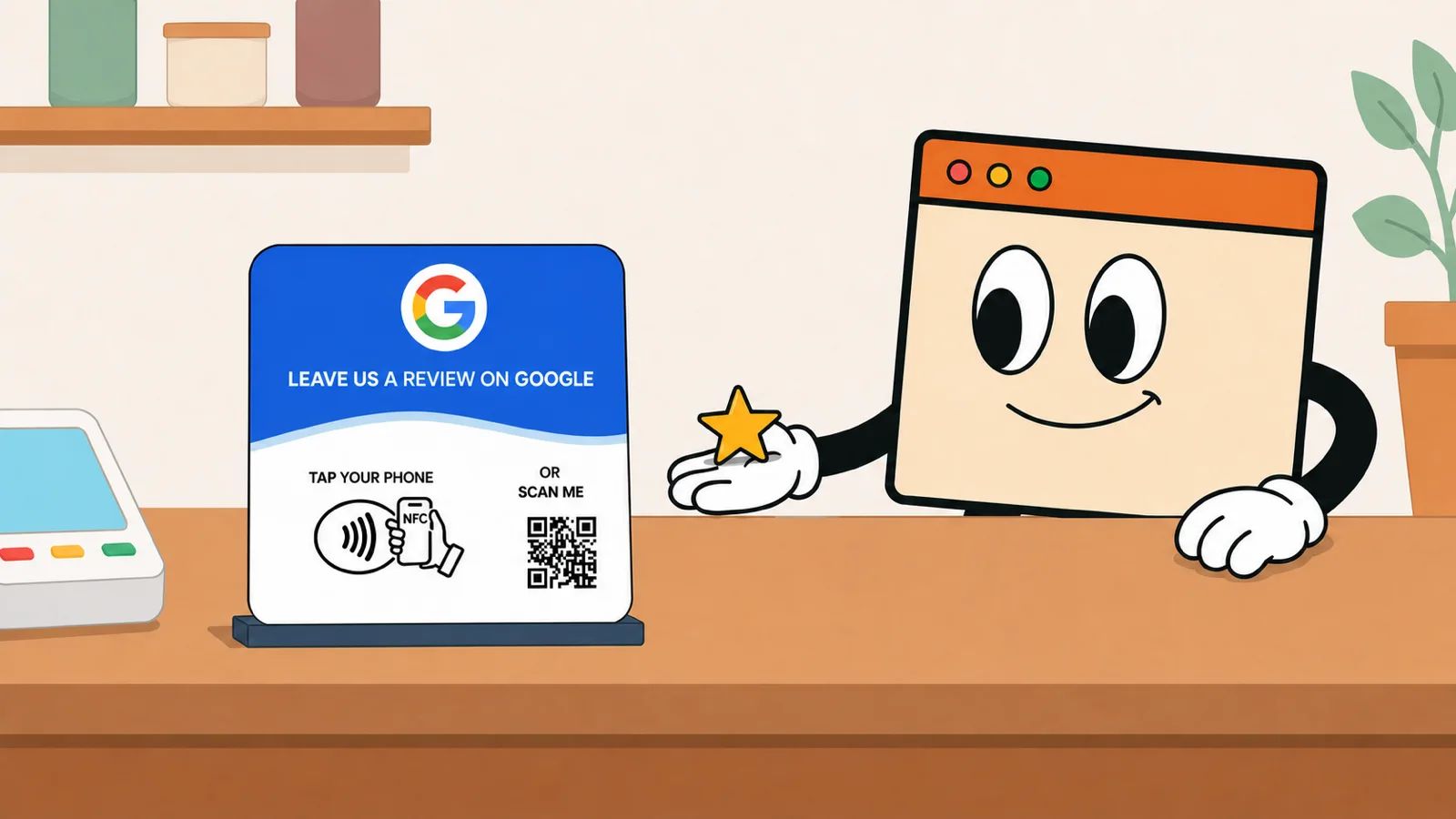
Ask everyone, ask soon after the job, and make it one tap. That is most of it. The part worth getting right is what you must not do, because several of the tactics sold as review strategy break Google’s policy or federal law, and the penalty for the popular ones lands on you rather than on whoever sold them to you.
If your profile is not set up yet, that comes first: how to get your business on Google Maps. And if the wider problem is that nothing about you appears at all, start with why your website is not showing up on Google.
What does Google actually allow?
Asking is allowed, and Google says so plainly. Its policy permits a business to “solicit or encourage the posting of content that does represent a genuine experience, without offering incentives to do so or attempting to influence the rating or the contents of the review.”
Three conditions sit inside that sentence, and each one rules out a common tactic:
| Condition | What it rules out |
|---|---|
| a genuine experience | reviews from friends, staff, or anyone who was not a customer |
| without offering incentives | discounts, entries into a drawing, free items, anything of value |
| without influencing the rating or contents | asking only happy customers, or telling people what to write |
Everything else is a matter of timing and friction.
What must you not do?
Four tactics, in rough order of how often they are recommended by people who should know better.
1. Offering anything in exchange. Google’s policy prohibits offering “incentives - such as payment, discounts, free goods and/or services - in exchange for posting any review or revision or removal of a negative review.” Note that this covers asking for a review at all, not just asking for a good one. A discount for “an honest review” is still an incentive.
2. Review gating. Asking how the experience went first, then sending the happy customers to Google and routing the unhappy ones to a private form. It is widely sold as reputation management and it produces a rating that does not reflect reality. Everyone gets the same request, regardless of how they seemed.
3. Pressuring people on the premises, or telling them what to say. Google’s policy states that businesses cannot “require or pressure users to leave ratings or write reviews while on the premises, nor should they request that specific content be included.” Handing someone a tablet at the counter and asking them to mention a particular service is both halves of that sentence at once.
4. Buying reviews, or writing them yourself. Beyond Google’s policy, this is federal law. The FTC’s Rule on the Use of Consumer Reviews and Testimonials, 16 CFR Part 465, took effect on October 21, 2024 and prohibits fake and misleading reviews, including reviews by insiders presented as customers, and buying positive reviews. It carries civil penalties.
🛑 A “review generation” service that promises a specific number of new reviews per month is describing something you should not want. Ask exactly how the reviews are obtained before signing anything, and treat vagueness as an answer.
When should you ask?
Timing does more work than wording.
- Within 24 hours of the job being finished, while the result is still in front of them.
- At the moment of visible relief or pleasure. After the repair works. After the delivery lands early.
- Not during the transaction. Asking while someone is paying introduces exactly the pressure Google’s policy prohibits.
- Not months later. Goodwill decays, and so does the specificity that makes a review useful.
How do you remove the friction?
Most customers who intend to leave a review never do, and it is almost always because the path was three steps too long.
- Get your review link. In your Business Profile manager there is a short link that opens the review box directly. Use it and nothing else.
- Send it by text. Text messages get opened. Email is second best.
- Write two sentences, not a template. Thank them, say the review helps people find you, paste the link.
- Put a QR code on the invoice, the receipt or a card they take away with them. On a card they take away, not a tablet you hold out.
- Ask once, follow up once. After that, stop.
Do not tell them what to write. “If you have a minute, a review would help a lot” is fine. “Could you mention the kitchen fitting and give five stars” is asking for specific content, which Google’s policy prohibits.
What about the bad ones?
You will get some, and the way you handle them is read by more people than the review itself.
- Reply to every negative review, briefly. Acknowledge, give one factual correction if there is one, offer to sort it out offline. Two or three sentences.
- Never argue, and never reveal anything about the customer. The audience is the next reader, not the reviewer.
- A few negatives make the good ones believable. A profile of nothing but five stars reads as bought.
- Flag reviews that break the rules, meaning fake ones or ones with no relation to a real experience. Not the ones you disagree with. This is slow and often unsuccessful, and it is not a substitute for gathering real ones.
The steady beat beats the burst. Ten reviews arriving over a year looks like a working business. Ten arriving on a Tuesday looks like what it is.
Where does the website come in?
Less than you might think, and this is worth being straight about because reviews get sold alongside websites.
Your site can hold a small number of quotes on the page where people decide, and it should link to your profile so someone who wants to check you out can. That is genuinely the whole contribution.
What is not in the package: managing reviews, running a review campaign, or any tool that gathers them. That is ongoing work rather than building a site, and the good version of it is something you do yourself in the ten minutes after finishing a job.
⚠️ I will not invent testimonials for a site, and neither should anyone else. Publishing a fabricated review is inside the same FTC rule as buying one.
One thing you should hear from me rather than discover on your own. The shop templates ship with six example product reviews, because a WooCommerce review is a comment and the design blocks that display them would otherwise arrive empty. They are placeholders: they carry no “verified purchase” badge, an admin notice reminds you they are there, and one button deletes all of them. Delete them before you open the shop. Leaving invented reviews on a live store is the exact practice this article tells you to avoid, and shipping them without saying so would be worse.
The questions that come next
Can I offer a discount for leaving a review?
How many reviews do I need?
Should I ask customers to mention a specific service?
Want a view on your own case?
Tell me your trade and what you already have. I will tell you what is worth doing, even when the answer is “not yet”.
Get a call backRead next
All articles
How to get my business on Google Maps
Creating and verifying a Google Business Profile, the eligibility rule that disqualifies some businesses, and the fields that change how often you appear.
August 30, 20268 min
Why is my website not showing up on Google?
Four things explain nearly every case, and only one of them is about SEO. How to tell which is yours in ten minutes, and what to do about each.
August 30, 20268 min
What pages should a small business website have?
The four pages every small business site needs, the two the law adds as soon as you collect anything, and the six that are sold to you and make the site worse.
August 30, 20268 min