How much does it cost to start a Shopify store?
The plan, the payment fees, the theme and the apps: what opening a Shopify store actually costs in year one, and the two lines that grow with your sales.
Around $370 to $490 for the first year on a free theme with no apps: $348 for the plan on annual billing, or $468 month to month, plus about $20 for the domain. Every app you add is $10 to $30 a month on top, and payment processing takes a percentage of everything you sell. The subscription is the small number. The line that actually decides your cost is payment processing, and it grows exactly as fast as your revenue does.
If you are still weighing a shop against a site that simply shows what you do, start with what a small business website costs, because a store is the more expensive answer in every case.
What are the unavoidable costs of a Shopify store?
Four lines, and only the first is a fixed monthly figure.
| Line | Year one | Grows with sales? |
|---|---|---|
| The plan | about $348 annual billing, $468 monthly | No |
| Payment processing | a percentage of every order | Yes |
| Domain name | about $20 | No |
| Theme | $0 on a free theme, more for a paid one | No |
Everything else, apps included, is a decision rather than a requirement. That distinction is worth holding onto, because the apps are where a $30 a month store becomes a $200 a month store.
What does the Shopify plan itself cost?
Three plans matter for a business that is starting out.
| Plan | Billed monthly | Billed annually |
|---|---|---|
| Basic | $39 a month | $29 a month |
| Grow | not recorded | $79 a month |
| Advanced | not recorded | $299 a month |
Annual billing takes roughly a quarter off. On Basic that is the difference between $468 and $348 for the year. The monthly figures for Grow and Advanced are blank on purpose: I recorded the annual prices and Basic’s monthly price from a US connection, and I am not going to fill the other two from somewhere else.
Almost every new store belongs on Basic. The higher plans buy lower card rates and more staff accounts, and neither is worth paying for until your volume makes the card rate difference exceed the plan difference. That crossover arrives later than most people assume.
What do the payment fees actually take?
This is the number to model before you open anything, because it is the one that scales.
On Basic with Shopify Payments, US online card transactions run at 2.9% plus $0.30 per transaction. The rate improves on the higher plans, to 2.7% and then 2.5%.
Here is what that costs at a $60 average order, which is a reasonable assumption for a small independent store:
| Monthly sales | Payment fees, per month |
|---|---|
| $1,000 | about $34 |
| $3,000 | about $102 |
| $10,000 | about $340 |
At $10,000 a month, payment processing costs more than eight times the plan. Anyone who tells you a Shopify store costs $39 a month is quoting the smallest line on the invoice.
⚠️ Using a payment provider other than Shopify Payments adds a further fee on top, from 2% on Basic down to 0.6% on Advanced. That fee is charged by Shopify for not using its own processor, and it is separate from whatever your chosen processor charges you. Check it before switching to a gateway that looks cheaper.
Where does the budget quietly go?
Three places, in the order they surprise people.
Apps. The store works out of the box. Then you want reviews, a proper email tool, a subscription option, better search. Each is $10 to $30 a month and each is individually reasonable. Six of them is a second rent. Add apps when a specific problem is costing you money, never in the first week.
The theme. Free themes are genuinely good now and are what most new stores should use. A paid theme is a one-time purchase, not a subscription, and it is worth it only when you know precisely what the free one will not do.
Product content. No platform writes product descriptions or takes product photos, and this is where store launches actually stall. Fifteen products means fifteen sets of photos and fifteen pieces of text. Budget the time, or budget somebody’s fee.
Shipping. Not a website cost, but it lands in the same month and it ruins more first-year plans than the platform fee does.
What do I charge for a Shopify store, and where I am the wrong person
I build Shopify stores as part of my middle package, EUR 1,190, and I want to be exact about what that does and does not cover, because a store is where quotes get vague.
What is included: I set up the store and enter up to 15 products with two variants each, from the names, prices and photos you give me. The site goes live within 15 business days of your confirmed start date.
What is not: writing your product descriptions. That stays with you, and it is the largest piece of work in a store launch. The Shopify subscription and payment fees are yours, paid directly to Shopify, and I never hold your account.
Where the fixed price stops. The package covers 15 products with two variants each, because that is what fits a fixed price. A larger catalog is not something I refuse, it is something I quote case by case: tell me what you sell before you go looking elsewhere, and you will get a number in writing before you commit to anything.
If online selling is the whole business rather than a part of it, with a catalog that changes weekly and stock to keep straight, that is a bigger job than a fixed price can hold. It is still worth a conversation: tell me what you sell and we work out what makes sense, rather than you guessing from a page.
And one thing to know before you choose Shopify at all: a Shopify theme cannot be moved. If you later transfer the account to yourself the store stays on Shopify, and going elsewhere means rebuilding. I tell clients that before they choose rather than after, and you should ask any provider the same question. The same ownership question, applied to ordinary websites, is worked through in Squarespace vs WordPress for a small business.
See the three packages and what each includes
Do you actually need a store?
A fair question to ask before spending any of the above, and the answer is no more often than the industry suggests.
Selling online costs money every month and takes real work every week: stock, orders, returns, product photos. If you sell a handful of items occasionally, a plain page listing what you have and a way to contact you will cost you almost nothing and lose you almost nothing. What pages a small business website needs covers what that looks like.
Open a store when you have proven that people want to buy, not to find out whether they do.
The questions that come next
Is there a cheaper way to sell online than Shopify?
Do I pay Shopify fees on orders I take in person or by phone?
How long does it take to open a store?
Want a view on your own case?
Tell me your trade and what you already have. I will tell you what is worth doing, even when the answer is “not yet”.
Get a call backRead next
All articles
How much does a small business website cost?
The three ways a small business site gets paid for, what each one really costs over three years, and the running bill that never shows up on the quote.
August 30, 202612 min
Squarespace or WordPress for a small business?
Who does the work, who owns the site, and what each really costs over three years. Written by someone who builds WordPress sites, so the losses are listed too.
August 30, 20268 min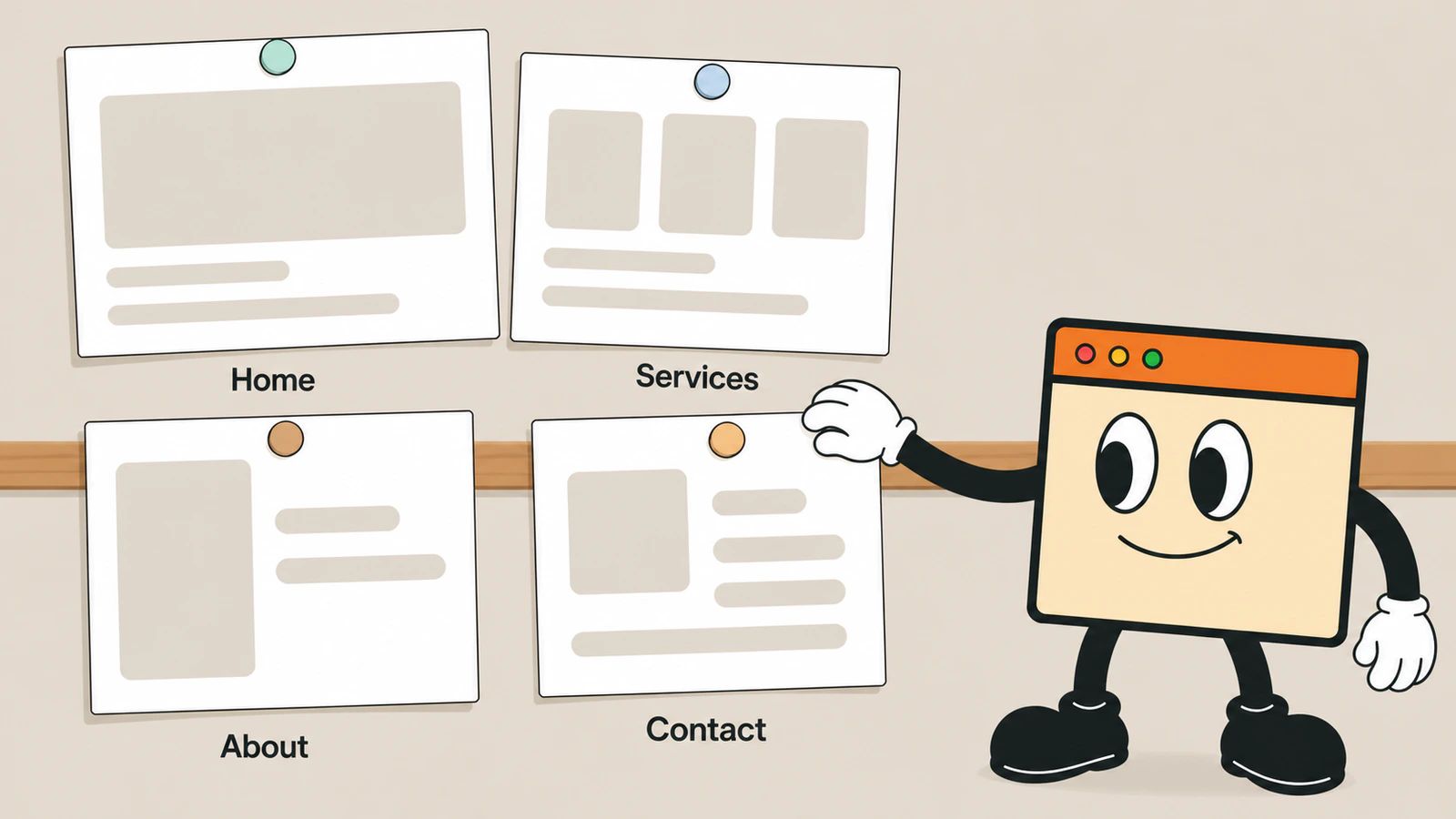
What pages should a small business website have?
The four pages every small business site needs, the two the law adds as soon as you collect anything, and the six that are sold to you and make the site worse.
August 30, 20268 min