How much does a small business website cost?
The three ways a small business site gets paid for, what each one really costs over three years, and the running bill that never shows up on the quote.
Somewhere between $600 and several thousand dollars over three years, and the spread has almost nothing to do with how many pages you get. It comes down to one thing: who does the work, and whether you are buying the site or renting it. Here are the three routes, with the numbers, including the one where paying me is the worse deal.
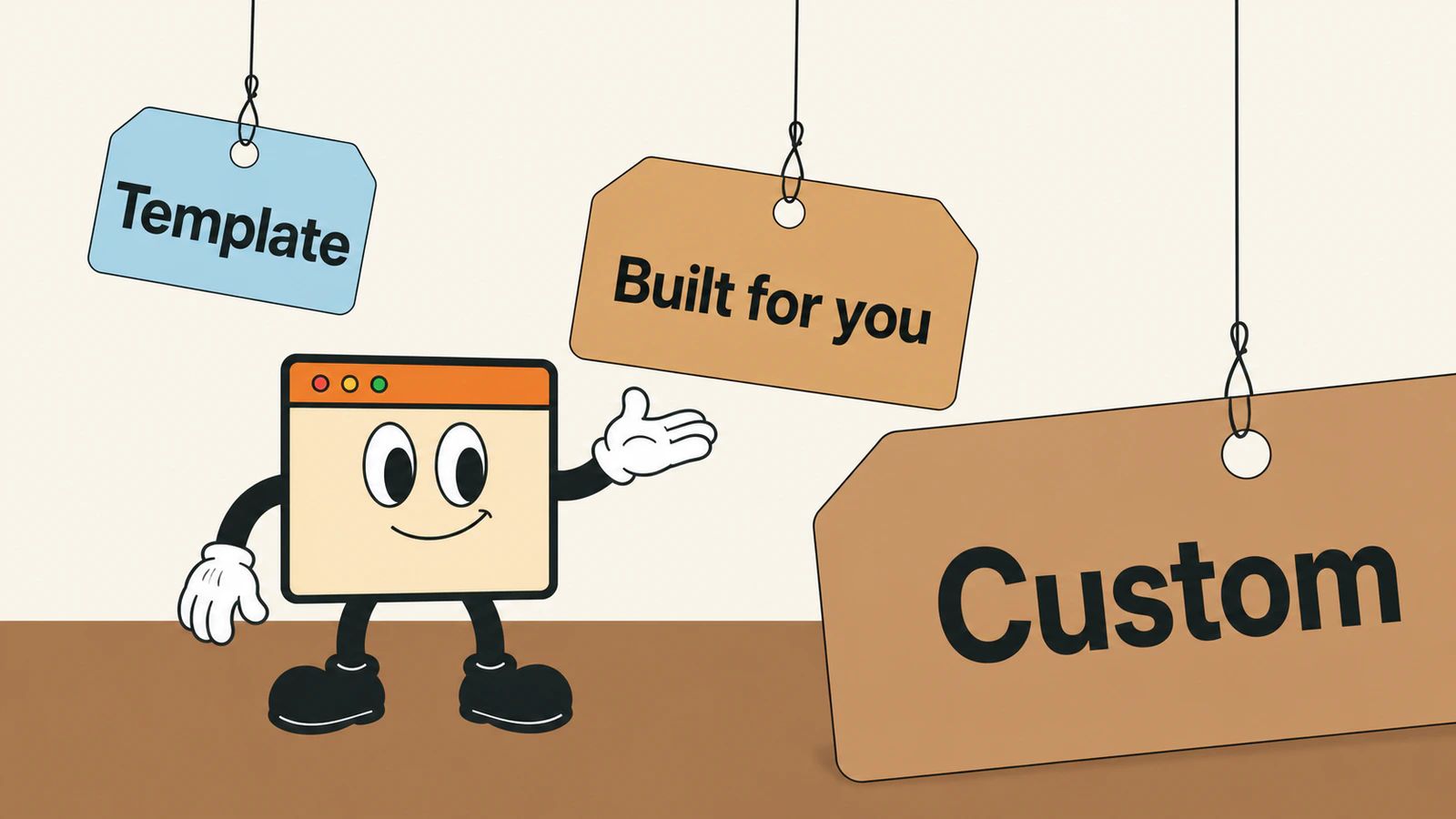
What are the three ways to pay for a website?
There are only three, and every quote you will ever get is a variation on one of them.
| Route | What you pay | Who does the work | What you own |
|---|---|---|---|
| A subscription builder | a monthly fee, forever | you | your text and photos. Not the site |
| Paid once, built for you | one price, then hosting | someone else | the site, the files, the domain |
| A custom project | a quote, usually five figures | a team | the site, plus whatever the contract says |
The first route is the cheapest in cash and the most expensive in dependence. The third is the reverse. The middle is where most small businesses actually land, and it is where this site sits.
The rest of this article is the total. The recurring half, what you keep paying every year whichever route you take, has its own section further down.
What does a subscription builder actually cost per year?
Less than almost anyone expects, and that is the honest headline of this article.
On annual billing, the entry plans sit at $17 to $19 a month, which is $204 to $228 a year. Mid plans run $29. The plans with real commerce features go to $39 and up. These were recorded from a US connection on August 30, 2026.
Three things move that number, and none of them appear on the pricing page you first land on:
- Monthly billing costs far more than annual. Squarespace advertises savings of up to 36% for paying a year upfront. That is not a discount you earn, it is a penalty you avoid.
- The free domain is a first-year offer. Squarespace gives one year of domain registration with an annual plan. In year two you pay for it like everyone else.
- The entry plan takes a cut if you sell. On Squarespace’s lowest tier there is a 2% transaction fee on the online store and 7% on digital content and memberships. The store fee drops to 0% on the tiers above; the digital content fee only reaches 0% at the top.
Over three years, an entry plan lands near $724 and a mid plan near $1,084, domain renewals included. Squarespace also runs discount codes from time to time, and one was live the day these were recorded: it applies to your first payment only, so it makes year one cheaper and changes nothing after that. The full arithmetic and the renewal traps are in what Squarespace costs per year.
If you are selling physical products rather than showing what you do, the numbers are different again and the platform fee is not the main event: see what it costs to start a Shopify store.
Why can’t I find agency prices anywhere?
Because agencies do not publish them, and that is a deliberate choice rather than an oversight.
You will find plenty of articles quoting “$5,000 to $15,000 for a small business site.” Follow the citation and it goes nowhere: another article, which cites another article. No agency publishes a price list, so no honest range can be built from public information. I am not going to repeat a number I cannot source.
What I can tell you is why the price is withheld. A quote given after a discovery call can be shaped to what you seem able to pay. A published price cannot. That asymmetry is worth money to the seller, which is exactly why so few give it up.
So the practical move is not to hunt for the true average. It is to ask any quote three questions:
- What is the total, in writing, before I commit to anything?
- What is not in it? Text, photos, logo, and the online store setup are the four that usually are not.
- What do I pay next year, and the year after?
What gets sold as monthly but does not have to be?
This is where a $10 a month website quietly becomes a $200 a month one, and it is worth separating the lines you cannot avoid from the ones you have been sold.
Genuinely unavoidable: hosting, and the domain name at roughly $20 a year. Together that is about $80 to $260 a year depending on the host you pick, which is the same range every total in this article is built on.
Everything else is a choice:
- Maintenance or “care” plans. Sometimes genuinely useful, often a retainer for work nobody performs. Ask what was actually done last month, in writing, before you sign rather than after.
- Page edits billed per change. Not a subscription, but it behaves like one. Twelve small edits a year at $40 is $480, which dwarfs your hosting.
- Plugin and app subscriptions. Each one is small. Six of them are not.
- Being locked into monthly billing on a builder. Squarespace’s own pricing page says annual billing saves up to 36%. Paying month to month is the most expensive way to hold a website there.
- SEO retainers sold alongside a website. A separate service and a separate decision, and no honest provider will promise you a position in exchange for one. Nobody controls Google’s ranking.
The test that sorts these quickly: if I stop paying this line tomorrow, does my website go offline? Hosting and the domain, yes. Almost everything else, no.
What is the bill that never appears on the quote?
This is where small business websites actually get expensive, and it is the part almost nobody prices in.
- Hosting. If the site is not on a subscription platform, it lives somewhere and that somewhere charges. Budget it as a real line, and use the renewal price rather than the introductory one.
- The domain name. Twenty dollars a year, give or take, every year, forever.
- Changes. This is the big one. A site where you cannot swap a photo or fix a line of text yourself is a site where every small change is an email, a wait and an invoice. Twelve changes a year at $40 each is $480, which is more than the site cost you to host.
- The renewal jump. Introductory pricing on hosting and on builders is a first-year number. Year two is the real one.
The single question that predicts your three-year bill better than any other: can I change a photo myself, on a Sunday night, without calling anyone? Ask for a demonstration on screen, not a yes.
What do I charge, and where does it lose?
Two fixed prices and one starting price, all given in writing before anything starts. They are billed in euros, which matters to a US buyer and I will come back to it.
- EUR 490 (coming soon): you build the site yourself, guided by filmed videos that show every step.
- EUR 1,190: I build it from your text and your photos. EUR 357 when you order, EUR 833 when the site goes live, and it is live within 15 business days of your confirmed start date.
- From EUR 2,400: custom-built, no template, designed for you. Both amounts go on the quote.
Hosting and the domain are opened in your name, on your accounts, and stay yours. The first year of the domain is included if it costs EUR 10 or less. On the two packages where I build the site, you get six months of questions by email, and the videos are an option at EUR 149 on the package I build from a template, EUR 89 on Signature.
Now the part that argues against me.
I ran the comparison rather than describing it. Three years of a $19 a month entry plan is about $724. Three years of my middle package is $1,430 to $2,208, depending on the exchange rate you pay at and what hosting you choose. The subscription is cheaper, and it is not close.
It stays cheaper for a long time. Against a $19 a month plan, paying once only catches up somewhere between year 8 and year 14, and with expensive hosting it never catches up at all inside thirty years. Against a $29 plan, it is year 5 to year 7 on cheap hosting, and year 12 to 14 if you pay $240 a year for it. Paying once wins on cash within a few years only if you would have ended up on a $49 a month plan anyway. I have no data on how many businesses end up there, so read that as the condition rather than the likely case: the online store fee already drops to zero at $29.
And two more things in the “against” column, since a comparison with no losses is not a comparison:
- You pay in euros. What that costs in dollars depends on the rate the day you pay, plus whatever foreign transaction fee your card charges. A US supplier does not put that on you.
- WordPress needs updating. The site I build runs on software that updates continuously, and I do not do those updates for you. A hosted builder does that part, and it is a real thing you are giving up.
So what is the money actually buying, if not savings? Ownership. The site is yours, the files are yours, the domain is in your name, and nobody can raise your rent or change the terms. If you leave, you leave with the site. On a subscription you leave with your text and start again. That is a real thing to pay for, and it is also completely reasonable to decide it is not worth the difference. On the figures above that difference is $700 to $1,500 over three years, depending on the exchange rate you pay at and the hosting you pick, and about $1,000 in the middle of the range.
See the three packages in full
Which route is right for which business?
| If this is you | Go here |
|---|---|
| You are testing whether the business works at all | A subscription. Do not buy an asset for a business that may not exist in a year |
| You have your text and photos, and you like tinkering | A subscription, or build it yourself with a guide |
| You are busy, the content exists, and you want it done | Paid once, built for you |
| You will keep this business more than five years | Paid once starts to pay off, slowly |
| You need something nobody else has | A custom project, and budget properly |
| Nobody at your company will handle software updates | Stay on a hosted builder, or budget someone to do them |
Whichever route you pick, the thing that decides your timeline is not the build. It is whether your text and photos exist. That is covered in how long it takes to build a website, and the reason it is the real bottleneck.
The questions that come next
Is a cheap website worse than an expensive one?
Do I have to pay every month for a website?
Can I start cheap and upgrade later?
Want a view on your own case?
Tell me your trade and what you already have. I will tell you what is worth doing, even when the answer is “not yet”.
Get a call backRead next
All articles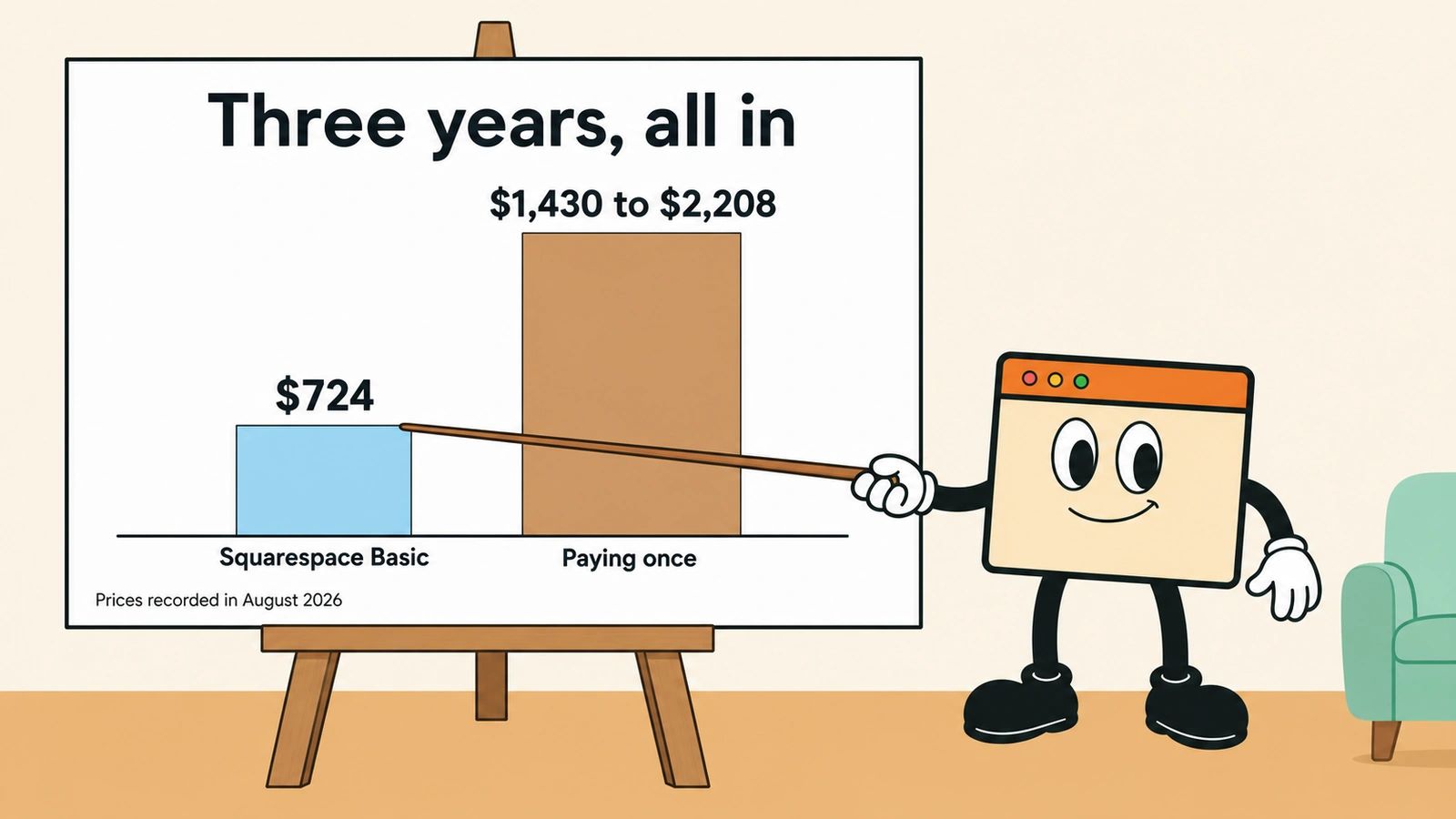
How much does Squarespace cost per year?
The yearly cost of each Squarespace plan, the fees that are not on the pricing page, and an honest three-year comparison against paying for a site once.
August 30, 202610 min
Squarespace or WordPress for a small business?
Who does the work, who owns the site, and what each really costs over three years. Written by someone who builds WordPress sites, so the losses are listed too.
August 30, 20268 min