Do I need a website for my small business?
When a Google Business Profile and an Instagram account are genuinely enough, when they stop being enough, and what a website does that neither of them can.
Not always, and anyone whose income depends on selling you one should say so plainly. If you run a local business where customers find you on the map and call, a Google Business Profile does most of the job for free. A website earns its place when people need to decide about you before they contact you.
When do you genuinely not need a website?
Four situations, and they are more common than the industry admits.
- You are booked out already. If your problem is capacity rather than demand, a website solves nothing and costs money.
- Every customer arrives through the map. Someone searching “barber near me” wants hours, directions, a phone number and photos. That is a Google Business Profile, and it is free.
- You sell through a platform that already has an audience. A marketplace or a booking platform brings people to you. A second storefront you have to fill yourself is work you may not need yet.
- You have not settled what the business is. A website written around a positioning you abandon in three months is money spent twice.
Start with the free thing first. If you are not on Google Maps yet, that is the higher-return move and it takes an afternoon: how to get your business on Google Maps.
What does a website do that a profile and an Instagram cannot?
Five things, and the first two are the ones that matter for most businesses.
1. It answers the questions that decide the sale. Prices, what is included, how you work, who you are, what happens if something goes wrong. A profile has no room for any of this. An Instagram grid buries it three months down.
2. You own it. Your profile lives under Google’s rules, your Instagram under Meta’s. Both can be suspended, restricted or reorganized without asking you. This is not a scare story, it is a plain fact about renting versus owning, and it is the same argument as Squarespace vs WordPress one level up.
3. It works when you are asleep. A prospect at 11pm reads your page. They do not send a DM and wait.
4. It can be linked to. A supplier, a journalist, a directory, a partner: they link to a website. There is nowhere to link to a Facebook post from 2024.
5. It gives your profile somewhere to send people. Your Business Profile is what gets you found on the map, and a website does not change that ranking. What it does is answer the questions the profile has no room for, at the moment someone taps through to decide.
Which comes first, the profile or the website?
The profile, almost always, and it is not close.
| Google Business Profile | Website | |
|---|---|---|
| Cost | free | from a subscription up to a project |
| Time to set up | an afternoon, plus verification | days to weeks |
| Gets you on the map | yes | no, not on its own |
| Shows hours, phone, directions | yes | yes |
| Explains your prices and your method | barely | yes |
| You control it | no | yes |
There is one eligibility rule worth knowing before you count on the profile: Google requires in-person contact with customers. Its guidance is that a business qualifies if it “has a physical location that customers can visit, or travels to customers where they are.” A rented mailing address you do not work from, a virtual office, is explicitly not eligible. Online-only businesses do not fit that model, and for them the website is not optional, it is the whole shopfront.
What happens if you never build one?
Three specific costs, all of which show up as things that quietly do not happen.
- You get compared and lose on absence. Someone weighing three providers finds two with sites explaining their work and one without. You do not get a chance to be more expensive for a reason.
- You answer the same questions forever. Prices, hours, what is included, how it works. Every one of those calls is unpaid time.
- You have nowhere to send anyone. Quotes, emails, a business card, a van: they all point somewhere, and a profile is a thin place to land.
None of that is fatal. Plenty of good businesses run for years without a website. It is a cost, not a catastrophe, and it is worth knowing the shape of it before you decide either way.
What is the smallest website that actually works?
Four pages. Not ten, not a blog, not a carousel on the homepage.
- A home page that says what you do, for whom, and where, in the first screen.
- A services or menu page with what is included, and prices if you can bear it.
- An about page with a real photograph of a real person.
- A contact page with a phone number, an address and a form.
What you do not need at the start: a blog you will not write, a gallery of thirty photos, a news section, a chat widget. What pages a small business website needs goes through which ones earn their place and which ones are sold to you.
The thing that will hold up your launch is not the build. It is having text and photos, and that is covered in how long it takes to build a website.
What does it cost to find out?
Three routes, and the cheapest is genuinely cheap.
Build it yourself on a subscription platform for $17 to $29 a month. Have someone build it once, which is what I do, for EUR 1,190, live within 15 business days of your confirmed start date. Or commission something custom, from EUR 2,400.
If you are testing whether you need a site at all, take the subscription. Buying an asset for a business you are still validating is the wrong order, and I would rather tell you that than sell you the middle package. The full comparison, including the years where the subscription stays cheaper, is in what a small business website costs.
One thing to sort out whichever route you pick: register the domain in your own name, on your own account, today. It is the one piece you cannot buy back if somebody else takes it, and it costs about $20.
The questions that come next
Is a Facebook or Instagram page enough instead of a website?
Will a website bring me customers on its own?
What if I only serve customers by referral?
Want a view on your own case?
Tell me your trade and what you already have. I will tell you what is worth doing, even when the answer is “not yet”.
Get a call backRead next
All articles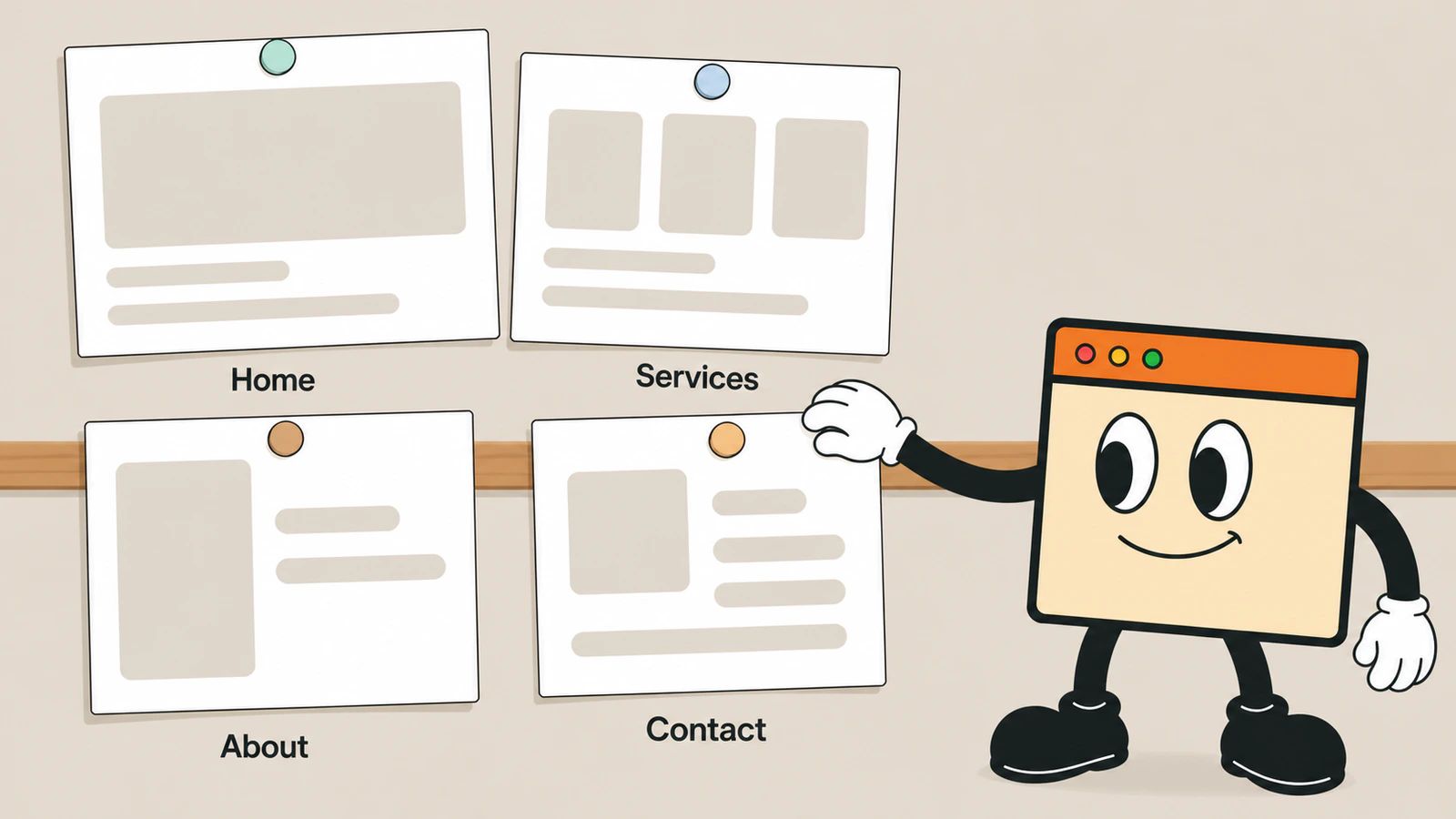
What pages should a small business website have?
The four pages every small business site needs, the two the law adds as soon as you collect anything, and the six that are sold to you and make the site worse.
August 30, 20268 min
How to get my business on Google Maps
Creating and verifying a Google Business Profile, the eligibility rule that disqualifies some businesses, and the fields that change how often you appear.
August 30, 20268 min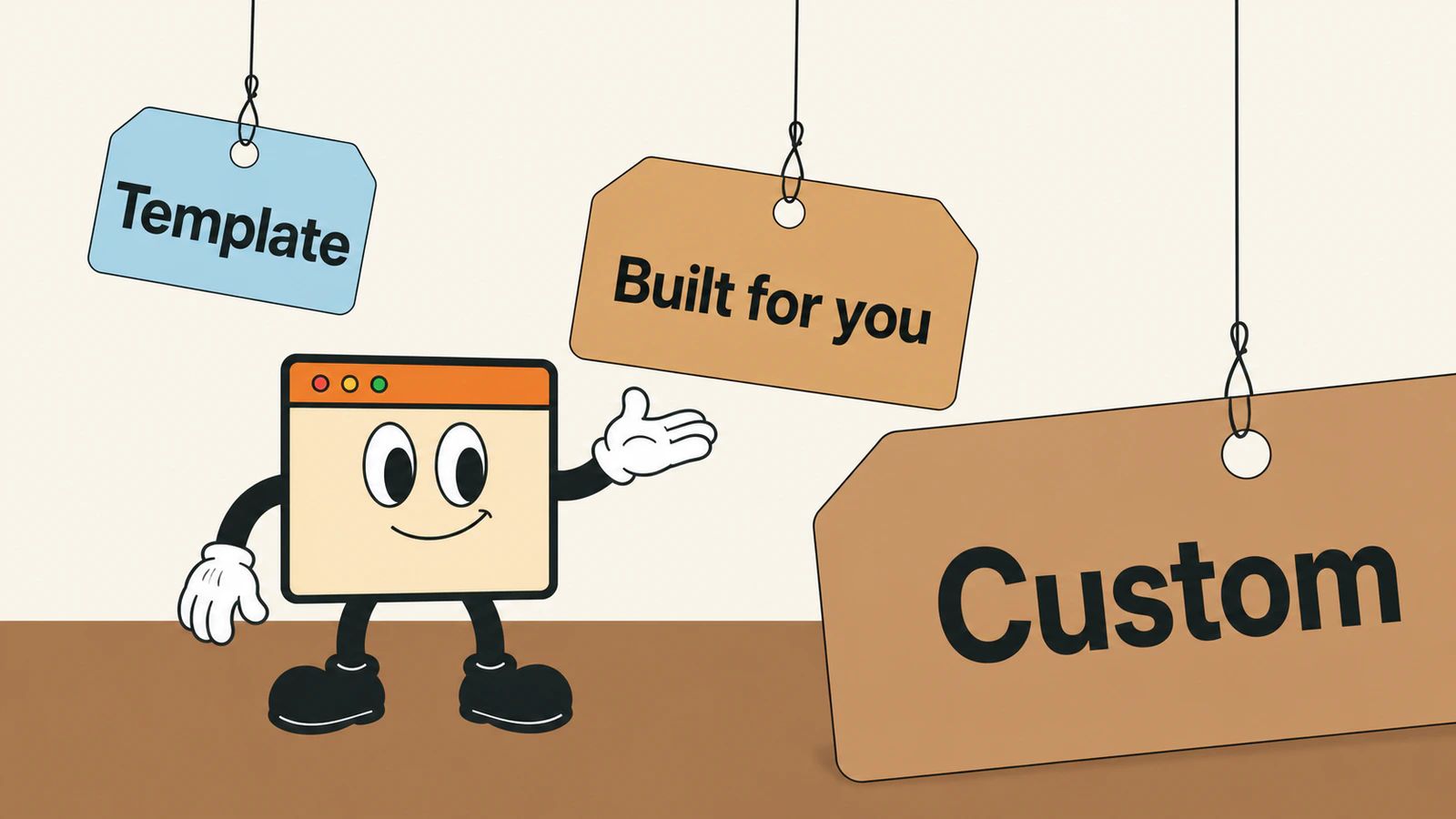
How much does a small business website cost?
The three ways a small business site gets paid for, what each one really costs over three years, and the running bill that never shows up on the quote.
August 30, 202612 min